I've been using Linux (on and off) for a long time now. But I've just moved back to it full-time on all my end devices, and I thought I'd talk about how I got here initially and why I came back.
(This is going to be equal parts about the tech and delving into my personal life so if that's not your vibe, feel free to click away now 🥲)
It was either late 2007 or early 2008. I had just got a laptop with Windows Vista - my dad got it for me when he got a redundancy payout from his previous job, as I had spent basically my entire childhood begging. As it was a Home Premium machine designed for it (not a shitty one that was upgraded or barely "Vista Capable") and as it was after a few patches had dropped already, it was a pretty decent experience. The only thing that I couldn't get running was stuff designed explicitly for XP - transformation packs, and the like. Things that replace system files.
That aside, the public opinion was strong. I had no issues with it, but I knew people did and I was easily influenced - I was like 10 or so for gods sake XD
We didn't see my grandmother very much, and she felt really guilty about that (I told you this was going to delve into my personal life loool - we're not even slightly into where we're going yet 😆) and so she decided pretty much out of the blue to start getting my sister and I a magazine subscription that was catered to our interests. I got a copy of PC Advisor delivered to my doorstep every month for a long time (can't remember quite how long). My sister got the Strawberry Shortcake official magazine, if you were interested.
I remember one month there was a tutorial section in there about installing VMware Player to experiement with programs you might not have wanted to install on your host OS, and also exploring alternative operating systems. This was the first time I ever heard what a virtual machine was, and also what Linux was.
In the article, they picked Damn Small Linux to advertise as a starting point and use as the basis of the tutorial. I guess that makes sense as it's, well, a damn small download and wouldn't need many system resources to run in a VM for people following along with weaker PC's.
I found the whole thing fascinating, though, and spent ages messing around with DSL in VMware Player on my laptop. As someone who only really knew Windows, learning there was a whole other world out there really intrigued me - I only barely knew what the Mac was at the time, and even though I think I knew they existed by this point I didn't really know what made them different from other PCs.
The next part of the story has two different versions in my memory where I've probably recalled it differently before and split it into two different timelines. I can't remember whether I found out about different distros and the larger ecosystem from:
- reading about it online, or
- a different issue of PC Advisor
I suspect the truth is that it's a bit from column A, and a bit from column B.
Linux occupied a weird part of the average Windows PC user's collective subconscious in 2008.
On the one hand, it was this anti-Windows - an antidote to Vista and Microsoft's monopoly. It was free, fairly stable, and most distros came full of software and utilities to get you working without having to pay for anything or even download anything extra (if you just wanted to get online and do some office work)
On the other, a lot of people had trust issues with both the compatibility and stability of a FOSS operating system, and people are naturally distrustful and think there must be a catch when something is just... given away. Not to mention that for the average person - especially in 2008 - the idea of switching operating system was quite daunting. As in the actual technical process of installing one.
I'm pretty sure I remember PC Advisor did a small spread on Ubuntu not long after their VMware/DSL tutorial. Maybe because there was some interest after that piece. I can't remember. But I'm sure I remember reading about the ShipIt servce in that magazine. And ShipIt is probably the trojan horse that got me to where I am today. XD
If it's before your time, or if you just didn't hear of it back then - ShipIt was a service offered by Canonical (Ubuntu's parent company) where they just... sent you a free bootable live CD-ROM of their operating system... just because you asked?
Like you filled out a form on their site and they sent you a disc. A nice disk, in a sleeve even!
I wondered back then and I wonder now how they ever afforded to operate that at scale. I get the whole increasing market share thing, but those discs cost money to make and ship. Not much individually, maybe. But for everyone who wanted them - including trolls and people who never even intended to use them? It can't have been cheap. Absolutely wild.
Regardless, it was a good idea. Internet was slower back then, with a lot of people either on rudimentary broadband or not even on it at all yet, still using dial-up. Being able to get the famously free operating system sent to you for genuinely free was a great marketing idea and a huge plus.
And I 100% took advantage!
I requested my Ubuntu 8.04 CD as soon as I heard about it, and patiently waited. And waited. I'm fairly sure it took quite a while. But it was free, you can't complain. XD
I knew that just booting the disc would take you to a live environment and let you play around with the OS. I know I definitely would have tried that out. What I don't remember is how long it took me to press "Install" and blow away the stock Vista image with nary a recovery image or disc left behind - my laptop was just new enough to have a built-in recovery partition instead of bundled discs. I'm fairly sure it had the option to make discs, but I never took it.
I was so enthralled by the other side that I got rid of Windows and went Linux full time. At 10 years old.
The prevailing memory I have of that time, though, was the feeling of misery.
Not because I inherently disliked Linux, or Ubuntu, or GNOME, but because it was pissing me off that none of the stuff I wanted to play from Windows worked.
I was big into Toontown at the time, and they of course didn't have a native Linux build. I can't remember if I ever got it running on Wine or if I just waited it out. (I definitely knew what Wine was as I came across it in my desperate struggles to get Windows stuff running again) But I couldn't easily get back to Windows without any recovery media.
I did eventaully manage to bounce back to Vista for a little while by finding a torrent of the install media borrowing a disc from a friend 👀 and using my OEM key from the CoA. I must have been really enamoured by Linux though, because I kept experimenting.
I remember I ordered Kubuntu 9.04 media when that OS was released because I was curious about trying a different DE after I learned they existed. I must have really liked KDE but not Kubuntu though, because my final destination for distrohopping was openSUSE. I downloaded overnight whatever the latest version of that was at the time and wrote that to a disc and installed it. I stuck that out until my Linux journey (temporarily) came to an end - not by choice.
I remember the last time I used openSUSE on that laptop, I was working on this website I was making to share some stuff with some friends I was in a club with. I was only just learning how it all worked with HTML/CSS etc and I was really bad at it (still am lol), but I did have something that worked with multiple pages and images and CSS etc - I was really quite proud of it, tbh.
My parents are seperated and I went to spend the weekend with my mum. When I came back to my dads house, my stepmum was literally in the process of having my stepbrother erase my openSUSE install and replace it with a Dell OEM copy of Windows XP without any of the right drivers pre-installed (!!!)
She told me she didn't know anything about this Linux stuff but I needed Windows and Microsoft Office for my schoolwork. She may have been at least a little right - especially considering that office suites on Linux were not as conmpatible with MS Office as they are today - and I may have even been receptive to the idea if she had 1) told me it was happening beforehand and 2) let me back up my freaking data!!!
I'm still angry about it to this day, even though in the grand scheme of things it was inconsequential to my larger life.
There are other reasons I'm no contact though lol, not just that 🙈
Regardless, that machine lived on XP for the rest of its days. I can't remember if I ever worked out where to get the drivers from - it was a own-brand rebadged ODM laptop from PC World, and I couldn't even tell you if they offered driver downloads for that thing back in 2008. It eventually developed a fault where it went from booting intermittently, to not booting at all </3
I remember that story so well because it was my first laptop, but my memory's a bit fuzzy after that. I think the next "PC" I had was a Dell netbook which came with XP. I definitely remember experimenting with Ubuntu on that also because I swear I tried the "Netbook Remix" they had going for a little while there, and hated the UI of it lol.
Over the years I've had loads of PC's (and Macs) that I've experimented with different OSes on, but I've never used Linux long enough to get "settled in", if that makes any sense. I'd try a live USB, install it, try and set it up to use day to day, and encounter some showstopping lack of feature or program and go back to Windows or macOS.
That brings us up to modern day basically.
In recent times, I've found myself in a bit of a cycle. It goes like this.
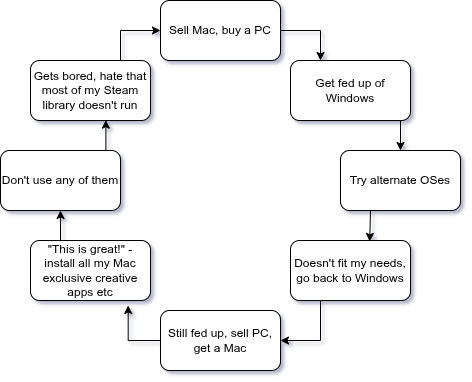
Only a few months back, I found myself back at the top of the flowchart - sold my M3 MacBook Air (and my iPhone + iPad for that matter) and got myself a 14" Ultrabook and a mini PC for my desk.
Running Windows 11, I started to notice that my mini PC would get LOUD. And in situations where I really thought it shouldn't.
Let me be clear - the thing has an Intel Ultra 9 285H CPU, and I've got it set in the BIOS to run in Performance mode. I get that means it will run louder than if I left it in the default Silent mode.
But this thing was running loud just booting Windows and sitting at the login screen. I know modern Windows can start running your startup apps before you've even logged in, but I had disabled anything I didn't need to boot with the system. And yet I'd press the power button, the fans would start quietly at first, and by the time I was looking at the Windows lock screen they would be audibly loud.
If I logged in to Windows and let it sit there for about 5 minutes, they would calm down again. But if I used more than say two browser tabs they would come back on. Quite loudly.
I pinned this down to Windows cruft and AI junk. But the more I thought about it, the more I realised I hated that. Both the bloat and the AI side of things.
I'd only just came back to the PC side, and I wasn't in any place to sell up again like a month or two into going back to PC as a platform. And I generally just didn't want a Mac again (yet loooool). And Linux was on the mind, as it almost always is even when I'm not a user of it (so much of my internet usage revolves around reading what's going on in the FOSS world, and I also deploy Linux wherever I can for backend solutions. For example my Jellyfin server has been based on Linux since I first set it up)
So I did what had to be done - I made a CachyOS USB and installed it on my laptop.
Felt like I was using a whole different computer, tbh.
My laptop has a Ultra 5 125H, 16GB RAM and 512GB NVMe storage. It's not a gaming laptop or a Ultra 5/9 high-end model, but it's a modern platform and it's no slouch. And it was "okay" under Windows, but only ever okay. On Cachy it felt like it was actually meant to feel.
On the mini PC side, it's a bit different. Windows 11 actually felt like a snappy OS with an Ultra 9 and 32GB RAM to balloon into play with. It was never the performance but the fan noise on there that bothered me. I mean it's FAST on Linux but the main change I've noticed is that it's whisper quiet unless I'm actually pushing it. Booting the OS, running like 10 browser tabs and having a bunch of other utilities like Discord and fooyin open have it sat silently as we speak. I've only heard the fan kick in when going to a site that uses WebGL or heavy acceleration, or running a game or a VM. Day to day usage keeps those fans off.
Idk if I've matured or Linux has, or if my needs have just changed but for the first time I don't feel like I'm missing anything either. Every single time I've tried a Linux switch in the past I've found myself going "I just need that, or I could stay here" and going back for like one particular program I use a ton.
This time I've got either an actual version of everything I use, or a really good alternative (e.g. the previously mentioned fooyin which, as a foobar2000 loyalist, I love tbh)
I do make liberal usage of Wine, Lutris, and Proton to run bits and bobs. For example (and this is so stupid) I run MSN Messenger 7.5 via Wine so I can use CrossTalk (as listed on my homepage <3) and I use Lutris to run Disney's Toontown Online. (yes, Toontown Rewritten has a native Linux build, but I sometimes play Sunrise Games's 2013 original client revival for nostalgia)
I also keep a Windows VM around for a bunch of other reasons. It feels like a safety net, and I love having VMs for everything tbh. Also my keyboard and mouse have configuration utilities don't run natively on Linux. They run under Wine, but they don't see the devices. And OpenRGB doesn't work right with my keyboard. It's really weird - it detects it and can change what the keyboard is doing, but wrongly? None of the options in the app line up with what my keyboard is actually doing. Idk.
I did move from CachyOS (my beloved) back to Fedora (which was my favourite before I discovered Cachy) because for the life of me I could not get VMware to compile it's kernel modules on Cachy. I think if I changed to a different kernel I could have got it working but I decided to go for something a tad less rolling and a tad more stable. I have been really tempted to go back to CachyOS but I don't want to distrohop and Fedora works great for what I need.
(I don't know if it's placebo or if their BORE scheduler actually makes a difference but Cachy did just... feel snappier - and I know there's different VM solutions to VMware but I've always been loyal to it and it feels like a "it just works" solution to virtualisation so I'm sticking with it xD)
But yeah, from first discovering it when I was 10(ish) in 2008(ish) to now where I'm finally using it full time as my desktop operating system again, that's my journey with Linux!
All that's left to be seen is whether PC+Linux is enough to break the PC+Windows <-> Mac cycle loooool.
(just shy of 2800 words - if you've stuck this out a] thank you and b] well done lol)